Writing Guides
How to humanize AI text without changing meaning
To humanize AI text without changing meaning, edit how the sentence reads while preserving what it claims. Keep the same facts, scope, conditions, certainty and source attribution. Then compare the rewrite with the original, claim by claim, before accepting it.
The worked examples below were constructed for this guide. They are illustrative edits, not Humaniser test results or findings from real studies.
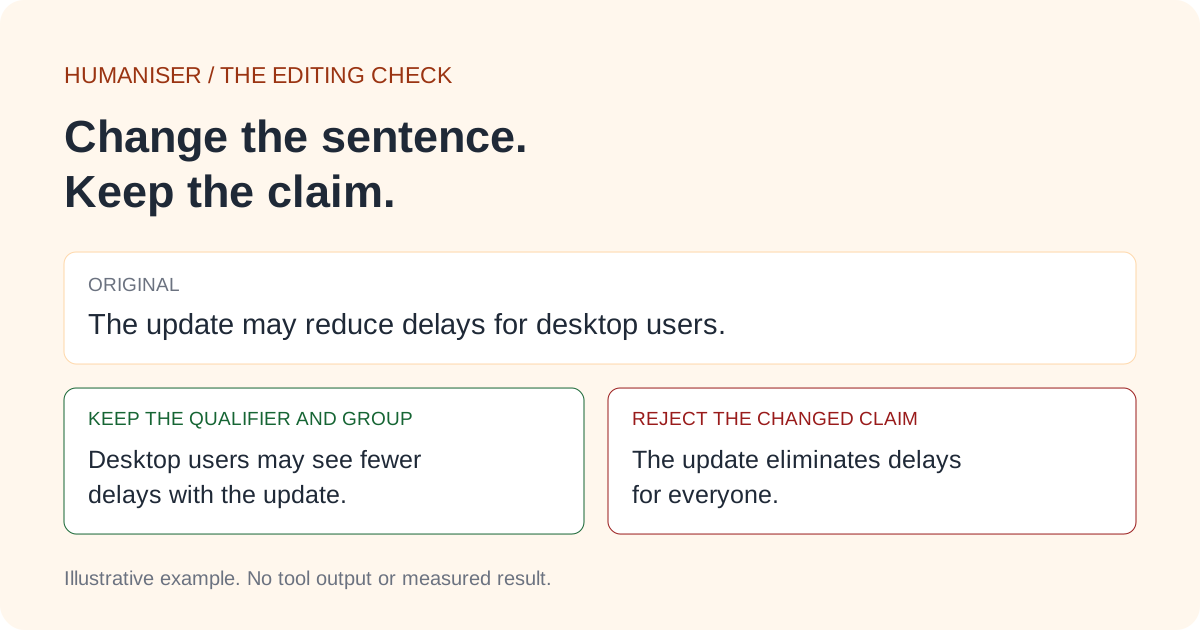
What must stay the same when you humanize AI text?
A sentence can keep its topic while changing its meaning. “The feature might help some users” and “The feature helps users” concern the same feature, but the second removes two limits. Similar vocabulary is therefore a poor test of whether an edit is faithful.
Before rewriting, make a short list of the details a reader would rely on: who did what, to whom, when, under which conditions, and with what evidence. Include small words such as “not”, “only”, “may” and “must”. Those words often carry more meaning than the long phrases you want to simplify.
Check the underlying facts first. If an AI draft contains an incorrect date or an unsupported statistic, preserving it faithfully still produces inaccurate writing. Correct it from a reliable source, record the correction, then start the style edit.
Choose the reader before choosing the tone. An incident report can sound natural while remaining formal. A customer email can use contractions without adding enthusiasm or promises the sender never intended. “More human” does not have to mean more casual.
A full paragraph, rewritten and checked
Consider this fictional release update. It has a small trial, a technical measurement and a limitation. Those details make it a better editing exercise than a vague sentence about productivity.
Original draft
During a two-week pilot involving 18 support agents, the median time required to locate a help article decreased from 80 seconds to 60 seconds after the new search filter was introduced. The pilot did not measure customer satisfaction. The filter is currently available only in the desktop dashboard. These findings suggest that the filter may help agents locate help articles more quickly, although a larger trial is needed.
Accepted rewrite
In a two-week pilot with 18 support agents, the median time to find a help article fell from 80 to 60 seconds after the new search filter was introduced. The pilot did not measure customer satisfaction. For now, the filter is available only in the desktop dashboard. The results suggest it may help agents find help articles faster, but a larger trial is needed.
The edit trims “time required to locate” to “time to find” and replaces “although” with “but”. It keeps the size of the pilot, the median, both times, the desktop restriction and the cautious conclusion. It also retains “after”: the passage does not establish that the filter alone caused the change.
| Detail to verify | Required in both versions |
|---|---|
| Scope | 18 support agents; a two-week pilot |
| Measurement | Median time to find a help article; 80 to 60 seconds |
| Sequence | The change occurred after the filter was introduced |
| Missing evidence | Customer satisfaction was not measured |
| Availability | Only the desktop dashboard, currently |
| Conclusion | Possible benefit; a larger trial is needed |
Fluent, but reject it
Our new filter helps every support team find answers 25% faster and deliver a better customer experience.
This version invents a customer outcome, generalizes from 18 agents to every team, and loses the desktop limit. “25% faster” also blurs a decrease in median time into a speed claim. The measured time fell by 25%; retaining the original seconds is clearer. A short, confident sentence is not automatically a good rewrite.
Six subtle mistakes to catch in a humanized rewrite
Use these pairs when reviewing your own draft. Each rejected edit sounds plausible until you compare the actual claims.
1. Possibility becomes a promise
- Original
- The new export option may save editors time on weekly reports.
- Reject
- The new export option saves editors time every week.
- Accept
- Editors may save time on weekly reports with the new export option.
The original describes a possible benefit. Dropping ‘may’ turns it into an established result. A more confident voice is a different claim.
2. Percentage points become a percentage
- Original
- The completion rate rose from 40% to 50% during the trial.
- Reject
- The completion rate increased by 10% during the trial.
- Accept
- During the trial, the completion rate went from 40% to 50%.
The difference is 10 percentage points, or a 25% relative increase: (50 − 40) ÷ 40. Keeping both endpoints avoids changing the calculation or its meaning.
3. A condition disappears
- Original
- Customers can export the report after an administrator approves access.
- Reject
- Customers can export the report whenever they need it.
- Accept
- Once an administrator approves access, customers can export the report.
The approval condition controls when the action is possible. Moving it to the start improves the sequence; removing it changes the permission.
4. An association becomes a cause
- Original
- In the survey, shorter meetings were associated with higher satisfaction.
- Reject
- Shorter meetings made employees more satisfied.
- Accept
- The survey linked shorter meetings with higher satisfaction.
The source describes an association, not a demonstrated cause. The rejected version also introduces ‘employees’, a group the original did not specify.
5. A technical term becomes an inaccurate synonym
- Original
- The dashboard displays median response time in milliseconds.
- Reject
- The dashboard shows average response speed.
- Accept
- You can see the median response time, in milliseconds, on the dashboard.
‘Average’ does not preserve the explicit choice of median. ‘Speed’ changes the quantity, and the unit disappears. Keep the term and simplify the surrounding sentence.
6. A source starts supporting two different claims
- Original
- The pilot included 24 volunteers [A]. We recommend a larger follow-up study.
- Reject
- The pilot involved 24 volunteers and recommended a larger follow-up study [A].
- Accept
- There were 24 volunteers in the pilot [A]. Our recommendation is to run a larger follow-up study.
The recommendation belongs to the writer, not necessarily source A. Keeping it in a separate sentence preserves that distinction. [A] is a fictional source marker for this example.
How do you preserve citations and technical terms?
Keep a citation beside the claim it supports. If you split a sentence, check which new sentence needs the reference. If you combine two statements, make sure the source supports both. A reference can remain spelled correctly while becoming attached to the wrong idea.
Purdue OWL explains that paraphrased information still needs attribution and recommends comparing a paraphrase against the original. That applies even when a tool helps with the wording. See Purdue’s paraphrasing guidance.
Leave direct quotations and bibliography entries outside a style rewrite. In a document with citation-manager fields, edit the prose around those fields and verify the final references in the document itself. Pasting plain text back into a document is not a check that the original citation links still work.
For technical text, make an exact-term list before editing: “median”, product names, measurement units, version numbers, or defined terms. Explain an unfamiliar term in a separate sentence if needed. Do not replace it with an approximate synonym simply to make the wording look different.
A prompt to humanize AI text while preserving meaning
Use this with a writing assistant that accepts instructions. Fill in the audience and protected terms. It separates the editing task from expansion and gives you a record to review. The prompt is a request, not a guarantee: verify the response yourself.
Edit the passage below for a clear, natural tone for [audience].
This is a style edit, not a summary or an expansion.

Preserve every claim, number, unit, date, named entity, comparison,
condition, negation and degree of certainty. Keep the writer's stance.
Do not turn an association into a cause or a possibility into a promise.
Keep these technical terms exactly: [list terms].
Leave direct quotations and reference entries unchanged. Keep each
citation attached to the specific claim it supports.
Do not invent examples, personal experiences, sources or results.
If a sentence is ambiguous, flag it separately instead of guessing.

Return:
1. The revised passage.
2. A brief list of substantive wording changes for me to review.
3. Any ambiguity or factual claim that needs checking.

Passage:
[paste the text]
If you use the Humaniser AI text editor, start with a passage whose claims you have already checked. Review the suggested rewrite beside your original using the same audit. Keep protected terms and source details in your own review notes, and accept only the edits that pass your comparison.
For a long draft, work on sections that contain complete ideas. Include the preceding sentence when a pronoun or comparison depends on it. After combining the edited sections, check the transitions: a locally clear paragraph can still contradict the paragraph above.
The final review: check meaning before style
Put the two versions side by side. For each claim in the original, identify the corresponding claim in the rewrite. Then reverse the check: find support in the original or verified sources for every claim in the rewrite. The first pass catches omissions; the second catches additions.
- Facts: same names, dates, numbers, units and comparisons?
- Scope: same people, platform, time period and exceptions?
- Certainty: same possibility, recommendation or obligation?
- Sources: each citation still supports the adjacent claim?
- Voice: no invented experience, stronger opinion or promise?
Reject an edit if one substantive detail fails, even if the rest sounds better. Once the facts match, read the revision aloud. Fix awkward phrasing, unclear pronouns and unnecessary repetition. Do not add errors or force unusual vocabulary to make the text appear less polished.
Download the plain-text editing checklist and keep it beside your next draft. For a broader publishing workflow, see our guide to humanizing blog posts.
Does humanizing text help SEO or AI search visibility?
A style edit can make a page easier to read, but rewriting alone does not establish expertise or add evidence. For a blog post, check whether it answers the reader’s actual question, includes useful examples and supports factual claims with sources.
Google’s guidance on generative AI content emphasizes value for users and warns against generating many pages without adding value. Rephrasing a generic draft does not resolve that problem.
For AI Overviews and AI Mode, Google says normal SEO practices remain applicable; no special AI markup is required. Its recommendations include accessible text, internal links and structured data that reflects the visible page. See Google’s AI features guidance. Clear, self-contained explanations are useful to readers and may be easier to reference, but neither a humanizer nor a particular writing format guarantees rankings or AI citations.
Frequently asked questions
Can I humanize AI text without a tool?
Yes. Identify the claims, remove empty phrasing, make the subject and action clear, then compare the result with the original. The accepted edits in this guide demonstrate that process. A tool can suggest alternatives, but the review is still necessary.
Should an AI humanizer change every sentence?
No. Keep sentences that already fit the audience and communicate accurately. Unnecessary rewriting creates more details to verify. If only the opening sounds stiff, edit the opening rather than repeatedly rewriting the whole document.
Does a low AI detector score mean the meaning is preserved?
No. A detector score is not a comparison of your original claims with the rewrite. It cannot replace the factual audit above. If a score is your concern, read how AI detectors work before using it to make decisions about a piece of writing. For a source-overlap result, our AI score vs similarity score guide explains which report to review and what each percentage means.
Can I use this method for academic writing?
Use it where your course, institution or publisher permits that kind of assistance. Preserve source attribution, keep your drafts, and follow any disclosure requirements. Accurate rewriting does not itself establish that the use of a tool is allowed. Our responsible AI writing guide covers the questions to resolve before editing.