AI Detector Insights
AI detector vs plagiarism checker: what the scores mean
An AI detector estimates whether writing may be AI-generated. A plagiarism checker looks for matches to existing sources. You can have low similarity and a high AI score because these checks answer different questions. Neither result, by itself, decides whether a piece of work breaks the rules.
Source documentation checked September 5, 2026. Report designs and institutional policies can change.
What does each checker actually measure?
“Plagiarism checker” is a common name for a similarity-checking tool. The important distinction is between finding a match and judging that match. A properly quoted sentence can match its source exactly. An uncredited idea can be expressed in completely different words.
Turnitin’s similarity guide describes a comparison against its database, with matching passages highlighted for review. Its score measures text overlap; it does not establish plagiarism. You need to examine the source and how the writer used it.
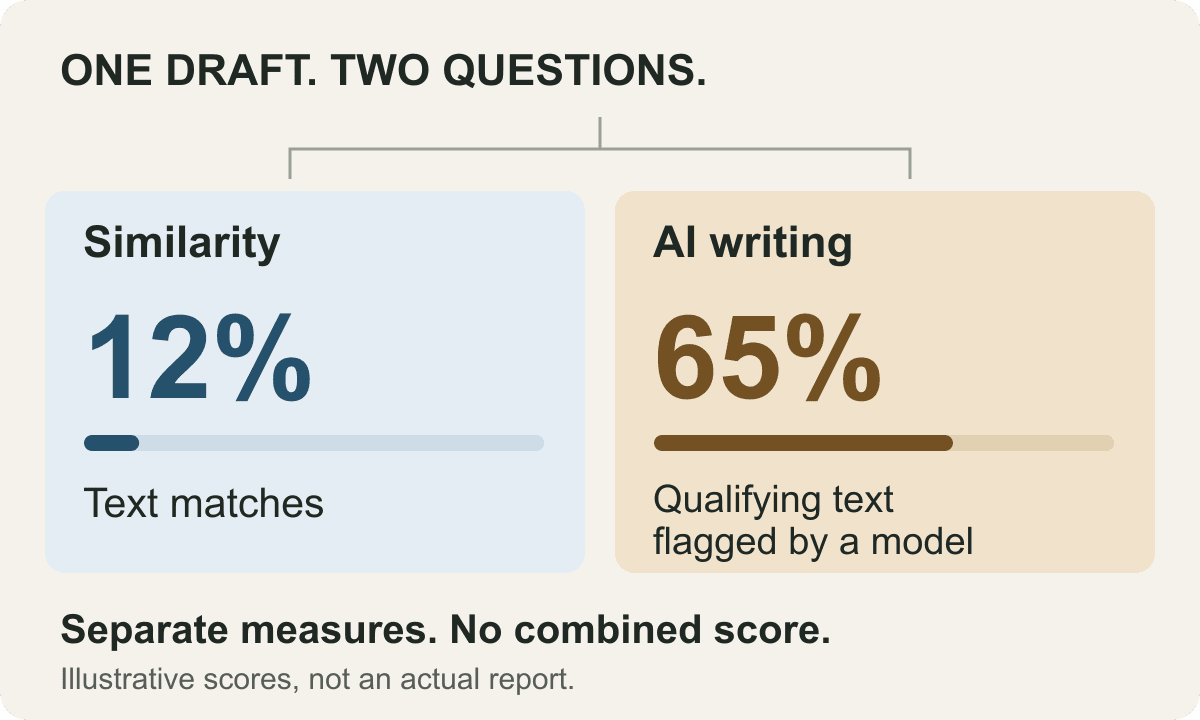
AI detection is a separate analysis. Turnitin explicitly says its AI-writing percentage is independent of its similarity score. Its AI Writing Report guide also warns that the model can misidentify text and should not be the sole basis for adverse action against a student.
| Compare | Similarity checker | AI detector |
|---|---|---|
| Question | Where does this wording match existing material? | Which text does a model flag as likely AI-generated? |
| Evidence to inspect | Matched passages and their sources | Flagged passages alongside drafts and writing context |
| Turnitin percentage | Text matching sources in its database | Qualifying text identified as likely AI-generated |
| What it cannot decide | Whether each match is acceptable source use | Whether a writer broke the applicable AI-use policy |
How to read an AI score vs a similarity score
Ask “percentage of what?”
For Turnitin, the AI percentage refers to qualifying text: prose in long-form writing. It is not a percentage confidence that the student cheated, and it need not describe every item in the file. Tables and other non-prose material are not reliably covered in the same way. See the qualifying-text definition before interpreting a number.
Other tools may label their output as a probability, confidence or text percentage. Read that product’s definition. A 60% probability estimate and a report marking 60% of eligible text describe different things, even though the large number looks identical.
Do not add, subtract or average the reports
Suppose the illustration above shows 12% similarity and 65% AI writing. Adding them to get “77% problematic” has no valid interpretation. Subtracting 65 from 100 does not establish that the rest was written by a human, either. The reports do not divide the document into mutually exclusive categories.
A paragraph could contain a source match and an AI highlight. Another could have neither. To find out whether the same passage appears in both reports, inspect the highlights; the headline percentages cannot tell you.
An asterisk or missing report is not a zero
Turnitin’s indicator guide says an asterisk (*%) represents an AI result in the 1–19% range, where it suppresses the precise percentage and highlights to reduce misinterpretation. An unprocessed submission or an error is a different state. Record what the report actually displays instead of replacing a missing number with 0%.
Four report combinations, and what to check next
These are constructed examples, not actual detector results or recommended cutoffs. “Low” and “higher” describe the examples relative to one another; they do not define an acceptable score for your assignment.
Example 01
Low similarity, high AI score
- Similarity
- 3%
- AI writing
- 76%
There is little reported source overlap, while the AI report flags much of the qualifying text. The results are not contradictory. Neither number explains how the draft was actually produced.
Next step: Open the AI highlights and compare those sections with your outline, saved revisions and any permitted tool use. A clean similarity report cannot resolve an authorship question.
Do not conclude: “Only 3% similarity proves the AI flag is wrong.”
Example 02
Higher similarity, no AI flag
- Similarity
- 38%
- AI writing
- 0%
Start with the matched sources. This could involve correctly marked quotations, a stored earlier draft, uncited copying, or a mixture. The AI result does not tell you which explanation applies.
Next step: Review each substantial match in context. Check quotation marks, attribution and earlier submissions before deciding whether a revision or an instructor review is needed.
Do not conclude: “The AI score is zero, so the source use is fine.”
Example 03
Both scores are low
- Similarity
- 2%
- AI writing
- 0%
There is little reported overlap and no AI flag. You still need to account for borrowed ideas, check that references exist and follow the assignment’s rules about assistance.
Next step: Read the draft against your source notes and assignment requirements. A paraphrased idea still needs attribution even if its wording does not match a source.
Do not conclude: “Two low numbers certify this paper as original.”
Example 04
Both reports need attention
- Similarity
- 31%
- AI writing
- 64%
There are source matches and AI flags. Some passages may appear in both reports. You cannot add the percentages and conclude that 95% of the paper is problematic.
Next step: Keep two review columns: source attribution and writing process. A single paragraph may need both checks, but each finding needs its own explanation.
Do not conclude: “31% plus 64% equals a 95% misconduct score.”
A source-use problem that scores cannot settle
Consider this fictional source note and two ways a writer might use it. The library, figures and source marker are invented for this exercise. No checker was run on these sentences.
Source A: a fictional library report
“The library extended its opening hours by two hours during the six-week exam period. Evening visits rose from 120 to 180 per week.”
Version 1: new wording, missing attribution
During exams, the library stayed open two hours longer. Weekly evening attendance increased from 120 to 180.
The writer changed the wording, but the figures and observation still come from Source A. Whether a checker finds a match is not the deciding question: the reader needs to know where this information came from.
Version 2: attribution and a bounded interpretation
Source A reports that weekly evening visits increased from 120 to 180 during a six-week exam period when opening hours were extended by two hours. That comparison alone does not establish why visits increased.
This version identifies the source, retains the time frame and separates the reported observation from the writer’s caution about causation. In a real assignment, replace “Source A” with the required citation and a complete reference to the real source.
Oxford’s plagiarism guidance explains that acknowledging sources applies to ideas as well as words. Purdue OWL’s paraphrasing method recommends understanding the passage, writing your own version, checking it against the original and recording the source. These are source-use checks you can perform regardless of a detector result.
What to do with your report, step by step
1. Identify the report and the exact submission
Write down the tool name, report type, file version, submission date and displayed result. If someone only says “Turnitin flagged it,” ask which report and which passages. A screenshot of one percentage leaves out the evidence needed for a useful discussion.
Check the settings too. Turnitin’s exclusions guide explains that filtering can exclude material such as quotations and bibliographies; student exclusions are temporary and do not change the official score the instructor sees. Two views with different filters should not be treated as equivalent reports.
2. Review source matches at passage level
Open the matched source. Is the passage a direct quotation, a paraphrase, a reference entry or an earlier submission? Check whether quotations are marked and whether citations point to the right source. If you cannot access the match, request help reviewing it rather than guessing what it contains.
Keep legitimate quotations when they serve the argument. If a passage is too close to a source, revisit what you understood and explain it independently with attribution. Removing a citation or replacing a few words only to reduce a number can leave the underlying problem unresolved.
3. Review AI highlights against your writing process
Use existing drafts, notes and revision history to explain how a flagged section developed. Describe any assistance accurately: brainstorming, translation, sentence editing and generating a draft are different activities. Compare what you did with the actual assignment policy.
Turnitin’s guidance on reviewing AI reports calls for contextual judgment rather than a score-only conclusion. Preserve the submitted version before editing it. If an allegation is already under review, ask about the review process before submitting a replacement. Do not manufacture earlier drafts or treat a second detector’s lower number as proof that the first is wrong.
4. Keep a short review worksheet
For every passage that needs attention, fill in the following fields. This turns “my score is bad” into a specific question that you or a reviewer can address.
- Passage
- Page or paragraph number, plus its opening words.
- Report finding
- Source match, AI highlight, both, or a report that did not process.
- Evidence
- Matched source and citation, or the existing notes and revisions that explain this passage.
- Question to resolve
- For example: is this quotation marked correctly? Was this type of assistance allowed?
- Action and reason
- Keep with explanation, correct attribution, revise where permitted, or ask for review. Record why.
A report-request template
Adapt this message to the facts. It requests clarification without assuming that a score proves or disproves anything.
Could we review the report for [assignment and submission date]?
I can see [report name and displayed result]. Please clarify whether
the concern is source similarity, AI writing, or both, and which
passages need discussion.

I can bring [existing drafts, source notes or version history] and
explain how I developed those sections. My use of writing tools was
[accurate description, including no use if that is true].

Please also point me to the relevant assignment policy and the next
step in the review process.
Where Humaniser fits in this process
If you use Humaniser’s AI detector, read its result as Humaniser’s own analysis. It is not an official Turnitin report and does not establish whether your sources are correctly attributed. Use the report from the product your instructor or editor actually referenced when discussing their concern.
When assistance is permitted and the task is improving awkward wording, the Humaniser editor can suggest a rewrite. Review it yourself, keep source credit and follow disclosure requirements. Our guide to preserving meaning when rewriting shows how to check those edits. A smoother sentence is not evidence of authorship or permission to use AI.
Common questions about AI and similarity scores
Does a plagiarism checker detect ChatGPT?
Source matching can find overlaps in any submitted text, including AI-generated text. It does not, by itself, identify which tool produced it. A platform may offer both similarity checking and AI detection, but those remain distinct reports. Newly worded output is not automatically free of attribution problems.
What is an acceptable similarity score?
There is no universal cutoff. Turnitin’s student guidance directs students to their syllabus, assignment instructions and institution’s expectations. Check those first, then review the actual matches. A numerical target cannot tell you whether one particular quotation or paraphrase is acceptable.
Does 0% AI mean 100% human-written?
No. A result with no AI flag is a report outcome, not a record of who wrote each sentence. Evidence about authorship comes from the writing process and its context. Likewise, an AI flag should prompt review, not be converted into a certainty about misconduct.
Can a humanizer fix plagiarism?
Changing wording does not supply missing source credit. Revisit the original, decide whether to quote or paraphrase, and cite it appropriately. If the concern is unauthorized AI assistance, rewriting also does not resolve that policy question. See our responsible AI writing guide for questions about permission and disclosure.